
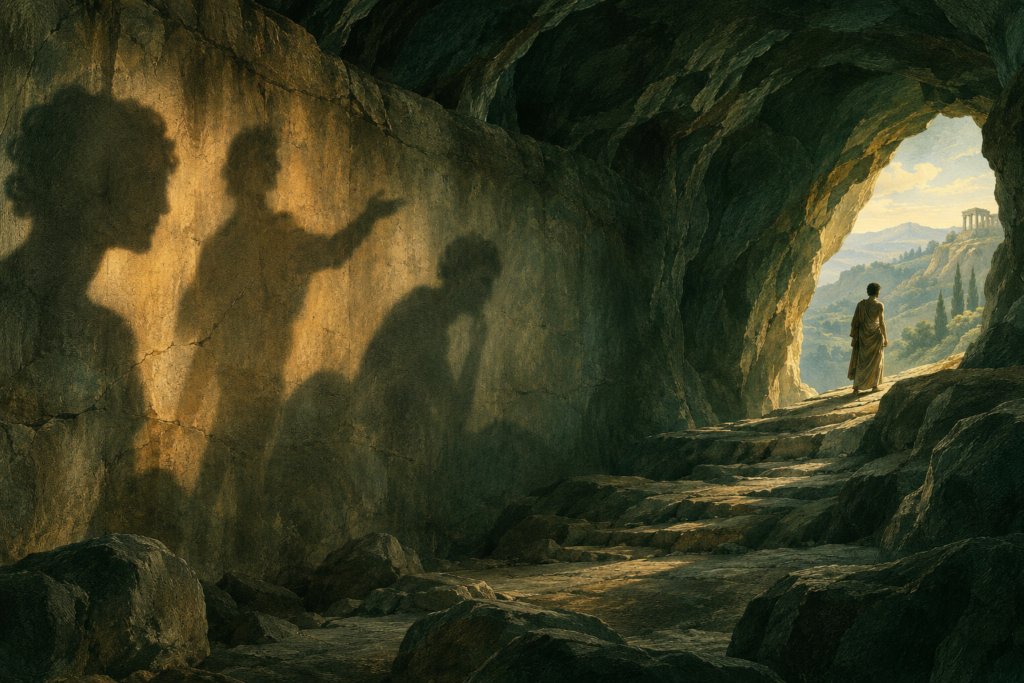
The fragile boundary between what we see, what we believe, and what is real.
The World Before Your Eyes
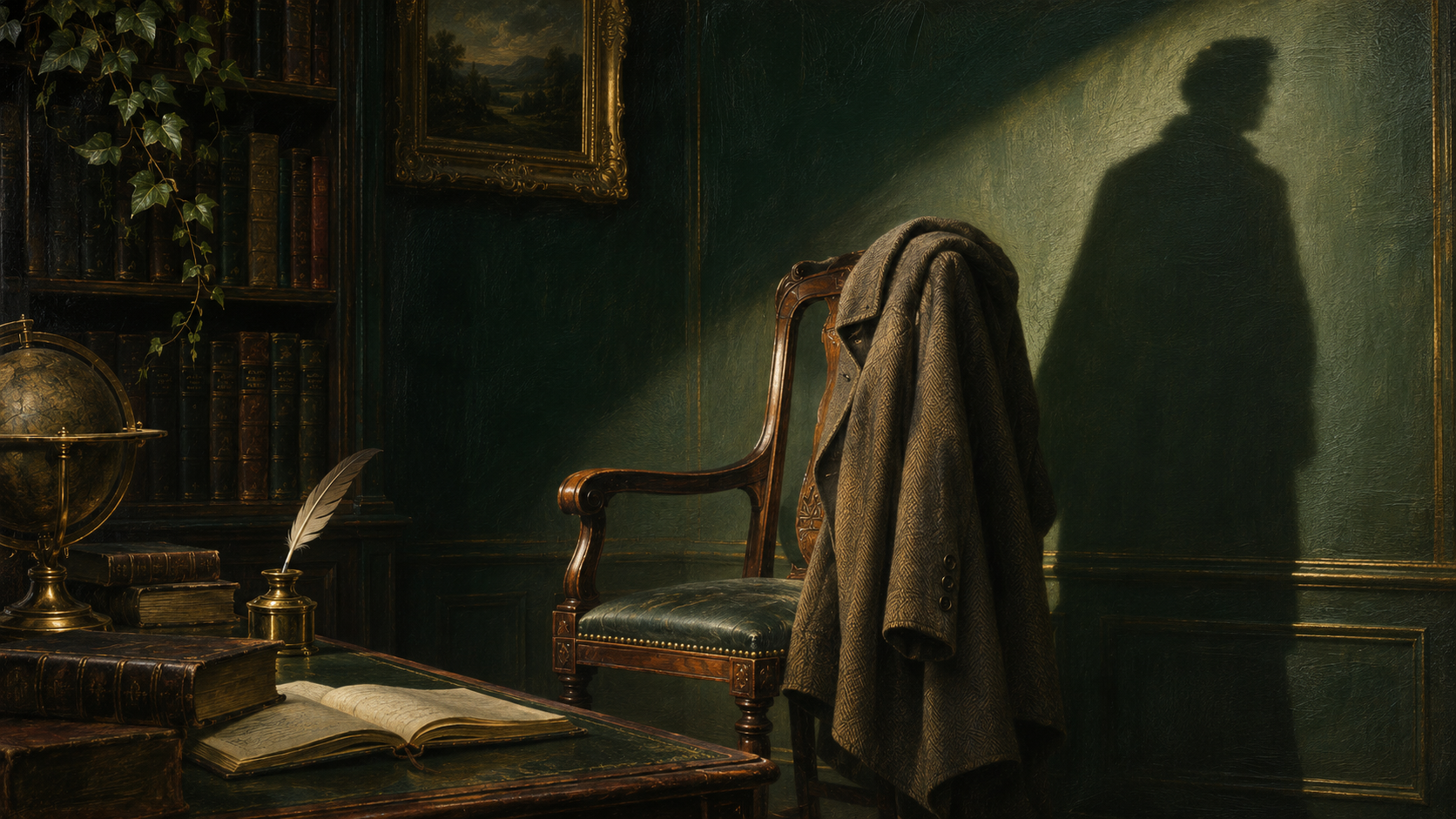
Imagine walking through a dark room. In the corner stands a figure, motionless, watching you.
For a brief moment, you are certain someone is there.
Then you turn on the light.
It is nothing more than a coat hanging over a chair.
The room has not changed. The objects have not moved. Yet the reality you experienced only seconds earlier has disappeared.
What changed was your interpretation.
Now consider a more uncomfortable possibility.
How many things in your life have you accepted as truth, simply because you have never thought to turn on the light?
We like to believe that we experience the world as it truly is. That our eyes show us reality, our memories preserve it, and our reasoning allows us to understand it.
But human perception is far more complicated.
What we experience is not merely the world around us. It is also the result of how our minds interpret that world.
And sometimes, the distinction is difficult to recognize.
The Mind Does Not Simply Observe
The human brain is not a passive observer.
It continuously processes sensory information, recognizes patterns, and uses previous experiences to interpret its surroundings.
Research in visual perception shows that expectations and context can influence what we perceive, particularly when sensory information is ambiguous.
This is not necessarily a flaw. It is part of what allows us to navigate a complicated world efficiently.
But the same processes that help us understand our environment can occasionally mislead us.
Consider an optical illusion. Two lines may appear to have different lengths, even when a ruler demonstrates that they are identical.
Knowing the truth does not always make the illusion disappear.
You can understand that your perception is mistaken and still experience it.
This reveals something remarkable: awareness and perception do not always agree.
And what begins as a simple visual illusion raises a much larger question.
If our minds can misinterpret something as measurable as the length of a line, how confidently should we approach more complicated judgments about people, intentions, memories, and events?
The Prisoners Who Mistook Shadows for Reality
More than two thousand years ago, the Greek philosopher Plato explored a similar problem.
In Book Seven of The Republic, he describes prisoners who have spent their entire lives chained inside a cave.
Unable to turn their heads, they can see only shadows projected onto a wall.
Because these shadows are all they have ever known, the prisoners mistake them for reality itself.
One prisoner is eventually released and brought out of the cave.
At first, the world beyond the cave is painfully unfamiliar. The light overwhelms him. Everything he believed he understood is challenged.
Gradually, his eyes adjust.
He begins to distinguish the shadows from the objects that produce them.
Plato’s allegory is not simply a warning that appearances can deceive. It is an argument about education, knowledge, and the difficult process of moving beyond inherited assumptions.
The prisoner does not become wiser merely because he leaves the cave.
He becomes wiser through the difficult process of learning to see differently.
There is an important distinction here.
Questioning what we believe is not proof that everything we have been told is false.
Nor does doubting conventional explanations automatically bring us closer to the truth.
A person who rejects every accepted belief without examining the evidence may have escaped one illusion only to construct another.
The purpose of questioning is not to replace certainty with suspicion. It is to replace unexamined belief with understanding.
The Illusions We Create Ourselves
Not all illusions begin with what our eyes perceive.
Some develop through the stories we tell ourselves.
Imagine two people receiving the same short message from a friend.
One interprets it as harmless.
The other, already worried about the friendship, reads it as cold and dismissive.
The message is identical. The interpretations are different.
Neither interpretation necessarily reveals the sender’s true intentions.
Psychology offers an important concept here: confirmation bias.
It describes our tendency to seek, notice, or favor information that supports beliefs we already hold, while giving less attention to contradictory evidence.
If you believe someone dislikes you, an ordinary silence may become evidence of hostility.
If you are convinced you cannot succeed, a single failure may seem to confirm your limitations.
Over time, interpretations can become beliefs, and beliefs can influence future interpretations.
A self-reinforcing cycle begins.
Yet recognizing confirmation bias does not mean our feelings are meaningless or our judgments always wrong.
It means that a strong conviction, on its own, is not sufficient evidence.
Sometimes the most useful question is not, Why is this happening to me?
It is, What else could explain what I am experiencing?
The Illusion of Knowing
There is another deception, more subtle than the others.
The belief that understanding something is the same as being certain about it.
We encounter information constantly: headlines, images, conversations, opinions, personal testimonies, and endless explanations of how the world supposedly works.
Some of this information is accurate. Some is mistaken. Some is incomplete. Some is deliberately misleading.
But information alone does not produce wisdom.
Neither does having an opinion.
The challenge is learning to distinguish what we know from what we assume.
A convincing explanation may still be false.
A popular belief may still be mistaken.
And an unfamiliar idea may deserve investigation without necessarily deserving acceptance.
This requires a particular kind of intellectual discipline: the ability to remain curious without becoming gullible, and skeptical without becoming cynical.
The world contains genuine mysteries.
We do not need to invent additional ones by abandoning the standards that help us distinguish reality from imagination.
Learning to See Beyond the Illusion
Escaping an illusion does not require us to distrust everything.
It requires us to become more attentive to how we form our conclusions.
When something feels unquestionably true, examine the evidence.
When another person’s behavior seems obvious, consider what you might not know.
When an explanation perfectly confirms what you already believe, ask what would challenge it.
And when you discover that you were wrong, resist the temptation to defend the mistake merely because it once belonged to you.
There is no shame in changing your understanding when better evidence becomes available.
In fact, that is one of the clearest expressions of intellectual maturity.
The greatest obstacle to understanding may not be ignorance itself.
It may be the conviction that we have already understood enough.
Beyond the Shadows
Perhaps we will never experience the world entirely free from interpretation.
Our senses, memories, experiences, and expectations are inseparable from the way we understand reality.
But that does not condemn us to illusion.
We can test our perceptions. We can compare perspectives. We can investigate evidence. We can learn from mistakes.
And, most importantly, we can recognize the limits of our own certainty.
The prisoner in Plato’s cave could not discover the world beyond the shadows while remaining convinced that the shadows were all that existed.
He first had to accept the possibility that his understanding was incomplete.
Perhaps that is where genuine insight begins.
Not with the declaration that we possess the truth.
But with the courage to discover that we might not.
The world is not always what it appears to be. Neither are we.
See what others overlook.
— The Seer
Sources & Further Reading
- Plato, The Republic, Book Seven — The Allegory of the Cave.
- Stanford Encyclopedia of Philosophy — Plato’s Middle Period Metaphysics and Epistemology
- American Psychological Association — Confirmation Bias
- Predictive Processing of Scenes and Objects — Nature Reviews Psychology
- Using Illusions to Track the Emergence of Visual Perception — Annual Review of Vision Science